About That Song: Liz Draper
About That Song #99
In our special series, singer-songwriter Sarah Morris interviews artists about the songs that shaped them.
Hi! I’m Sarah Morris. I’m wildly in love with songs and the people who write them. There have been a few songs in my life that have been total gamechangers—songs that made me want to be a songwriter and songs I’ve written that made me feel like I am a songwriter. About That Song is a space where I can learn more about those pivotal songs in other writers’ lives.
For our 99th edition, I was thrilled to connect with the amazing bassist Liz Draper to talk about influential songs in her life and tracks from her stunning recent EP.
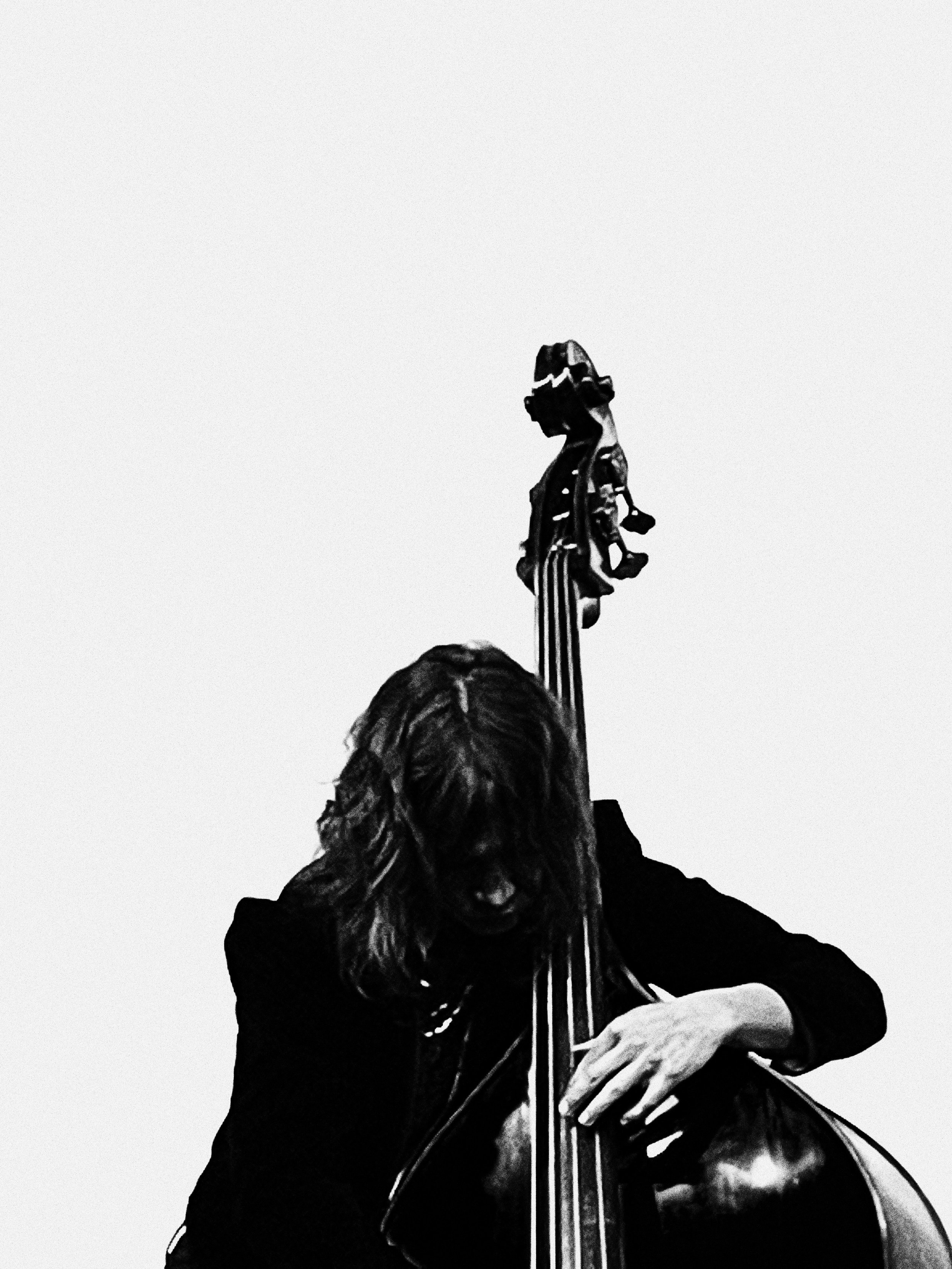
Liz Draper. Photo credit: Matt Irwin.
Sarah: Hi, Liz Draper! Welcome to About That Song. As a highly regarded classically and jazz-trained bassist, you’ve performed, recorded, and toured with a blisteringly cool and diverse array of musicians—Low, The Okee Dokee Brothers, Charlie Parr, Soul Asylum, The Rose Ensemble, to name a few. One summer, years ago, I had the great fortune to make music with you myself, and I remember feeling like I’d won some kind of ridiculous lottery.
Recently, after decades of appearing on the recordings of others, you set up a microphone in your hallway to record your debut solo record. The result is the 4-song, utterly gorgeous EP Meno, which your bio says “fits squarely in the genre of classicaldoomfolkjazz.” I'm a huge fan of squishing words together to make new words, and I'm also a huge fan of this record, so I'm wondering if we could talk a bit about the songs that have brought you to where you are on your journey.
Do you remember the song you heard that made you want to be a songwriter? Tell us about that song.
Liz: I was extremely lucky to grow up in a home immersed in music, surrounded by a plethora of musical instruments strewn about. My father is a percussionist and jazz drummer. I don’t remember ever separating the idea of playing music from engaging in the creative process and “writing” my own melodies, rhymes, etc. I took piano lessons and violin lessons from the age of 4. I was also always really drawn to all of the minor songs in my lesson books, like “House of the Rising Sun.” I just loved playing and singing that one in the piano lesson book—go figure. Ha.
I have early memories (either of my own or ones told so often by my mom that they feel like my own) from before I was speaking in sentences, of LOVING to sing along with “I Love L.A.” by Randy Newman. I would chime in with the chorus gang vocals hook response “we love it!” What a great song—still love it.
Sarah: Ah, yes, that is a great song! With so much music around, how did you find your way to the bass as your primary instrument?
Liz: I spent my early years in Fairmont, MN. Surprisingly, they had a great public school orchestra program there that started kids in 3rd grade! I eventually traded piano for the guitar, then the electric bass, dabbled with a bit of cello, but once I finally tried the upright bass—boom, that was it. I immediately fell in love with the instrument and just became obsessed.
Sarah: What’s your relationship with composition? Have you composed throughout the years? I believe I first heard you as part of your band Black Blondie, which was formed in 2006. Were you writing songs as part of that experience?
Liz: Throughout my middle and high school years, my dad had a weekly jazz gig. One time, his bassist had to bail last minute, and he offered me the gig. I was 13 or 14, and cramming to make my way through “Giant Steps” changes. Definitely a “fake it till you make it” experience.
Jazz provided a window into the world of theory and improvisation. I had already been making up songs with my friends in “punk” bands and playing local all-ages shows, but it was through this hands-on jazz experience that I learned technical aspects of composition.
In high school, during the late 90s, I formed jazz ensembles with peers and became involved in the local Minneapolis hip hop and spoken word scene. All of which was very improvisation-heavy. This led to the band Black Blondie. To this day, Black Blondie is one of my favorite projects I’ve been in. We were a true old-school band in the sense that we all brought song ideas to the table and wrote collectively.
Sarah: Your opening track, “Prayer for Mim in the Color Marigold,” offers the listener an invitation to the album via accordion, upright bass, and the occasional hum. It’s a study in contrasts—the bright of the accordion, the dark of the bass—it’s brief, it’s powerful, it’s haunting. Can you tell us about that song?
Liz: “Prayer for Mim” is exactly that. Music has always been the way I process change, sit with a feeling, how I build an altar for memories in the midst of loss and inner chaos. My first experience with losing a peer was to suicide in 9th grade. I locked myself in my bedroom for hours and just improvised on my bass.
It’s a blessing that we have art and music in this life to use as vessels to pay our respects and get lost for a while. Mim was a dear friend and bandmate who I had the great fortune to tour with in the band Low up until her passing from cancer. This song came from pressing “record” while trying to calm my mind and heart through reflective improvisation in honor of Mim. I eventually returned to the recording and sifted through what poured out. Kept the parts I felt worth keeping and built a final composition from there.
When I perform this piece live, each section is extended, and I leave room for improvisation. I often choose to spend a lot of time in major pentatonic tonalities because when I think of Mim, I think of how she was always adding beauty, strength, and positivity to every situation and every setting. The tonality resonates with my memories of her regal being.
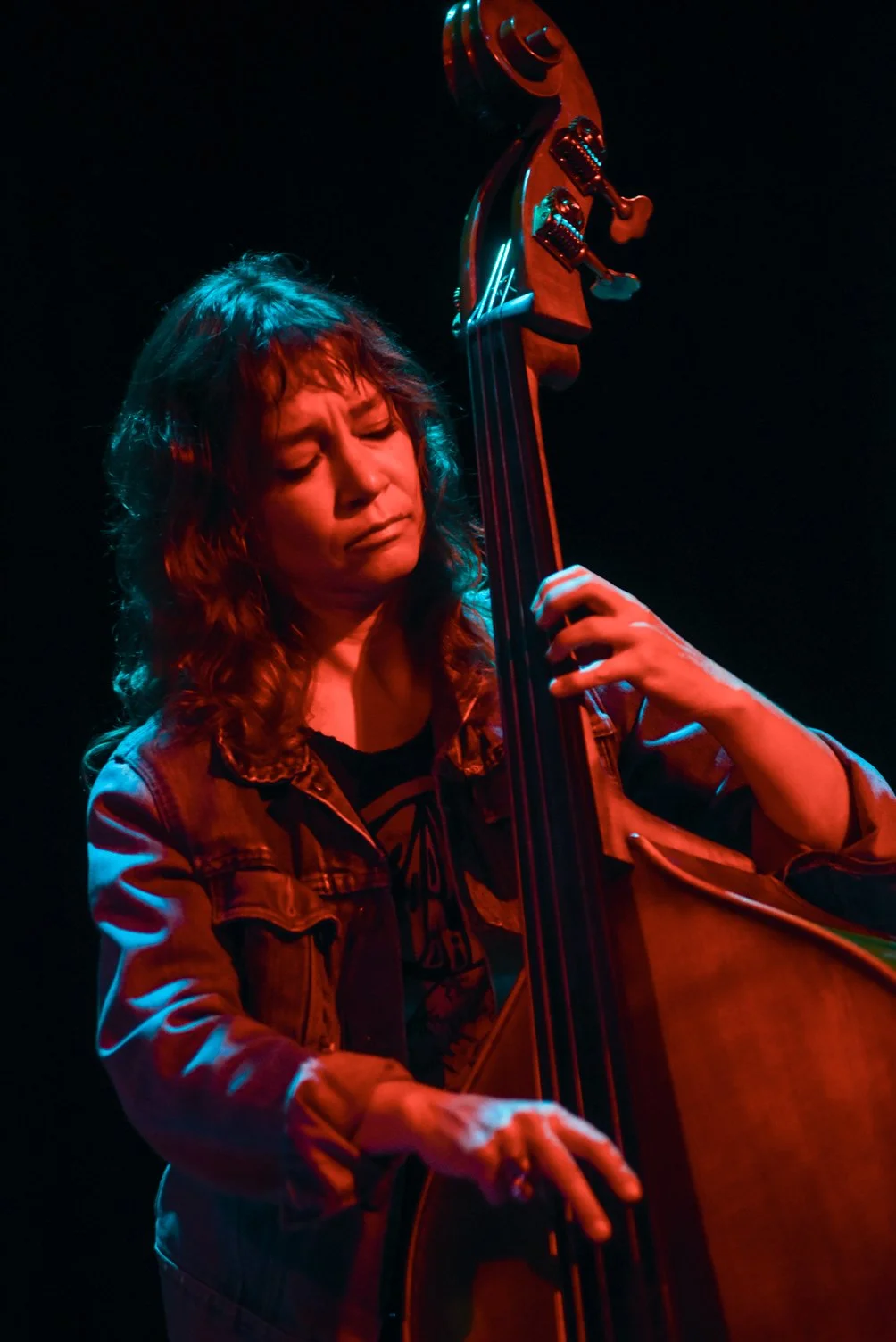
Liz Draper. Photo courtesy of the artist.
Sarah: Thank you for sharing that with us. The idea that you build in time for improvisation in every performance—that sounds to me doubly impactful here, in that it allows you time to reflect on her memory and presence. What a beautiful thing. On the EP, that song leads us calmly to “Groningen Nevel,” where we hear the conversational powers of the double bass on full display. What can you tell us about that song?
Liz: “Groningen Nevel” was written while I was on tour, stuck in a hotel with Iris DeMent, someone I consider one of the greatest songwriters of our time. It’s an absolute honor to be her bassist and her friend. We were staying in Groningen, a picturesque ancient city in the Netherlands. Iris came down with COVID. It hit her quite hard. At that time, 5 days of isolation was recommended.
It was fall. Every day there was a hazy, misty rain which the Dutch call “nevel.” My hotel window stayed cracked open. I had a beautiful view of the old city. I could see and hear many different bell towers in the skyline and began recognizing their timing patterns. I incorporate many elements of 5 in “Gronigen Nevel” as an homage to my 5-day isolation—harmonies of 5ths, 5-note melodic, pitch and tone clusters, 5/4 and 5/8 rhythms, etc. There is also a section of major harmonic arpeggios as a nod to the bell towers.
Sarah: Oh my word, am I glad I asked! Clearly, there is so much to enjoy as a listener—first, the tune as a whole. Then there are these opportunities to notice the layers, and the themes (and the 5s!).
The final track, “November,” ends with a phrase that seems to silence mid-sentence. And then… footsteps? Shuffling of the instrument being laid down? As a listener, I was thrilled by this moment—even as I wished there was more of this record to listen to. Can you tell us about that song?
Liz: It has been a dream of mine for a long time to have my own album, and more specifically to have a vinyl. I imagined the “right time” to record one would somehow magically present itself, but in reality, I just had to make it happen. When my body started entering perimenopause, I had a bit of a “shit or get off the pot” moment with myself. I set a concrete goal to deliberately devote the time and effort into finally just doing it. A lot of people get “baby fever,” as did I. It’s just my ovaries were knockin’ and really wanting to create a solo album, not a human baby. Meno is an overall reflection of aging and acknowledgment to change.
“November” is technically the oldest piece on Meno. I’d been messing around with some of its melodic themes for a few years under the working title “Before November Reigns.” The main theme was written in November on a rainy day before a presidential vote. Ultimately, the song metamorphosed quite a bit with time and I thought the longer title was sorta cheesy. I also truncated the piece quite a bit to fit within the album. I really don’t know why, but I really wanted Meno to be a 10-inch.
Thanks for noticing the little hidden sounds! I tracked the record myself. I’ve got a soft spot for Bright Eyes. I love how Conor’s albums often add little live room soundclips. I find it really charming. They add a raw and tangible element to his records. Like, oh yea, this is actually a moment in time being played by a human. A HUMAN! We need all the humanity right now. So, when I was listening to playback and heard the sound of the bow getting placed back in my quiver followed by footsteps, it seemed like the appropriate album closer.
Sarah: OH, we DO need all the humanity right now. Yes, thank you. Thank you for this gorgeous piece of art that fits just right on a 10-inch vinyl. And thank you for stopping by to talk About That Song with me. Wishing you all the best things, Liz Draper!
Listen to “November”
“November” Single Credits
Composed, performed, and recorded by Liz Draper
Mixed by Drew Temperante and Liz Draper
Mastered by Ava Mendoza
ABOUT THE AUTHOR

Sarah Morris. Photo credit: Tom Smouse.
Sarah Morris is a superfan of songs and the people who write them, and a believer that certain songs can change your life. A singer-songwriter / mama / bread maker / coffee drinker who recently released her fifth album of original material, she’s been known to joyfully sing with people in her Big Green Bathroom.